
Explore
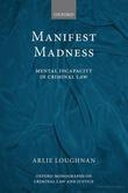


Whether it is a question of the age below which a child cannot be held liable for their actions, or the attribution of responsibility to defendants with mental illnesses, mental incapacity is a central concern for legal actors, policy makers, and legislators when it comes to crime and justice. Understanding the terrain of mental incapacity in criminal law is notoriously difficult; it involves tracing overlapping and interlocking legal doctrines, current and past practices including those of evidence and proof, and also medical and social understanding of mental order and incapacity. Bringing together previously disparate discussions on criminal responsibility from law, psychology, and philosophy, this book provides a close study of mental incapacity defences, analysing their development through historical cases to the modern era. It maps the shifting boundaries between normality and abnormality as constructed in law, arguing that ‘manifest madness’ — the distinct character of mental incapacity revealed by this interdisciplinary approach — has a broad significance for understanding the criminal law as a whole.
This book is included in DOAB.
 swampwitch

Rights Information
Are you the author or publisher of this work? If so, you can claim it as yours by registering as an Unglue.it rights holder.Downloads
This work has been downloaded 695 times via unglue.it ebook links.
- 378 - pdf (CC BY-NC-ND) at OAPEN Library.
Links
DOI: 10.1093/acprof:oso/9780199698592.001.0001Editions