
Explore
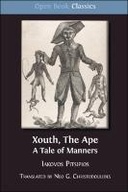


Xouth, the Ape', published in 1848 by Iakovos Pitsipios is a pioneering and satirical Greek novel that deftly blends humour, cultural critique, and biting social commentary. The novel is set in the aftermath of the Greek War of Independence. The story follows a young Greek man, desperate to present himself as a European aristocrat, who finds himself entangled with Xouth—an ape who is, in fact, a German travel writer transformed as punishment for his vanity and prejudices. Through the interactions between the protagonist and the ape-valet, Pitsipios skewers the pretensions of Greece’s newly minted elites, exposing the often comical efforts to mimic Western manners and ideals. The novel lampoons the wave of Western travel writers who ‘discovered’ Greece, poking fun at their colonial attitudes and superficial observations. The figure of Xouth serves as both a mirror and a caricature, reflecting the absurdities of identity, authenticity, and cultural imitation in a society striving to define itself between East and West. Translated in English for the first time, with an expansive Introduction by Neo G. Christodoulides, the novel explores themes of national identity, the pitfalls of mimicry, and the complexities of cultural exchange. Rich with allusions to both Greek and European literary traditions, Pitsipios draws sharp parallels between his characters’ quests for legitimacy and the real historical debates around language, class, and belonging in 19th-century Greece. The novel’s polyglossic style—a blend of archaic, official, and colloquial Greek—further emphasises the layered and fractured nature of Greek identity at the time. Despite its initial obscurity, the novel’s relevance endures: its sharp satire and insightful social analysis make it not just a humorous adventure, but a revealing document of post-revolutionary Greece and its ongoing negotiations with modernity, Western influence, and self-perception. 'Xouth, the Ape' is a hidden gem that deserves renewed attention from readers, scholars, and anyone fascinated by the crossroads of cultures.
This book is included in DOAB.
Why read this book? Have your say.
You must be logged in to comment.
Rights Information
Are you the author or publisher of this work? If so, you can claim it as yours by registering as an Unglue.it rights holder.Downloads
This work has been downloaded 24 times via unglue.it ebook links.
- 24 - pdf (CC BY) at OAPEN Library.
Keywords
- Ape valet
- cultural identity
- Greek satire
- Post-independence Greece
- thema EDItEUR::D Biography, Literature and Literary studies::DB Ancient, classical and medieval texts
- thema EDItEUR::D Biography, Literature and Literary studies::DS Literature: history and criticism::DSK Literary studies: fiction, novelists and prose writers
- thema EDItEUR::F Fiction and Related items::FU Humorous fiction::FUP Satirical fiction and parodies
- thema EDItEUR::N History and Archaeology::NH History::NHT History: specific events and topics::NHTB Social and cultural history
- thema EDItEUR::N History and Archaeology::NH History::NHT History: specific events and topics::NHTR National liberation and independence::NHTR1 Decolonisation and postcolonial studies
- Travel writing parody
- Western mimicry
Links
DOI: 10.11647/OBP.0493Editions